Demo Stylish Article
Résumé
This document is only a demo explaining how to use the Stylish Article template.
Mots clés
template, demo
1 Introduction
La question de la diversité des forêts tropicales fascine les écologues parce qu’elle a des enjeux très importants (Gibson et al. 2011) est qu’elle est difficile à comprendre (Wright 2002). Des modèles la décrivant ont été publiés (Liang et al. 2022).
A l’heure des menaces sur la biodiversité (Fadrique et al. 2026), une connaissance plus détaillée de la diversité des forêts très étudiées est utile.
Dans cet article seront comparées les diversités de Paracou (Gourlet-Fleury et al. 2004) et de BCI (Raby 2017).
2 Matériel et méthodes
- Les analyses sont réalisées avec R (R Core Team 2026) et le package divent (Marcon et Puech under review).
- Présentation du site de Paracou : La forêt de Paracou est située en Guyane française (Gourlet-Fleury et al. 2004). Les données de ce site sont vérifiées grâce à une transposition sur une carte Wapa.
- Présentation du site de BCI : La forêt de Barro Colorado Island ou BCI est située à Panama (Raby 2017).
- Les données sont vérifiées à l’aide d’une courbe rang-abondance.
- La valeur de la diversité pour les deux sites est faite en fonction de son ordre (Tothmeresz 1995; Patil et Taillie 1982).
3 Résultats
Création d’un tableau d’abondances avec une ligne par site.
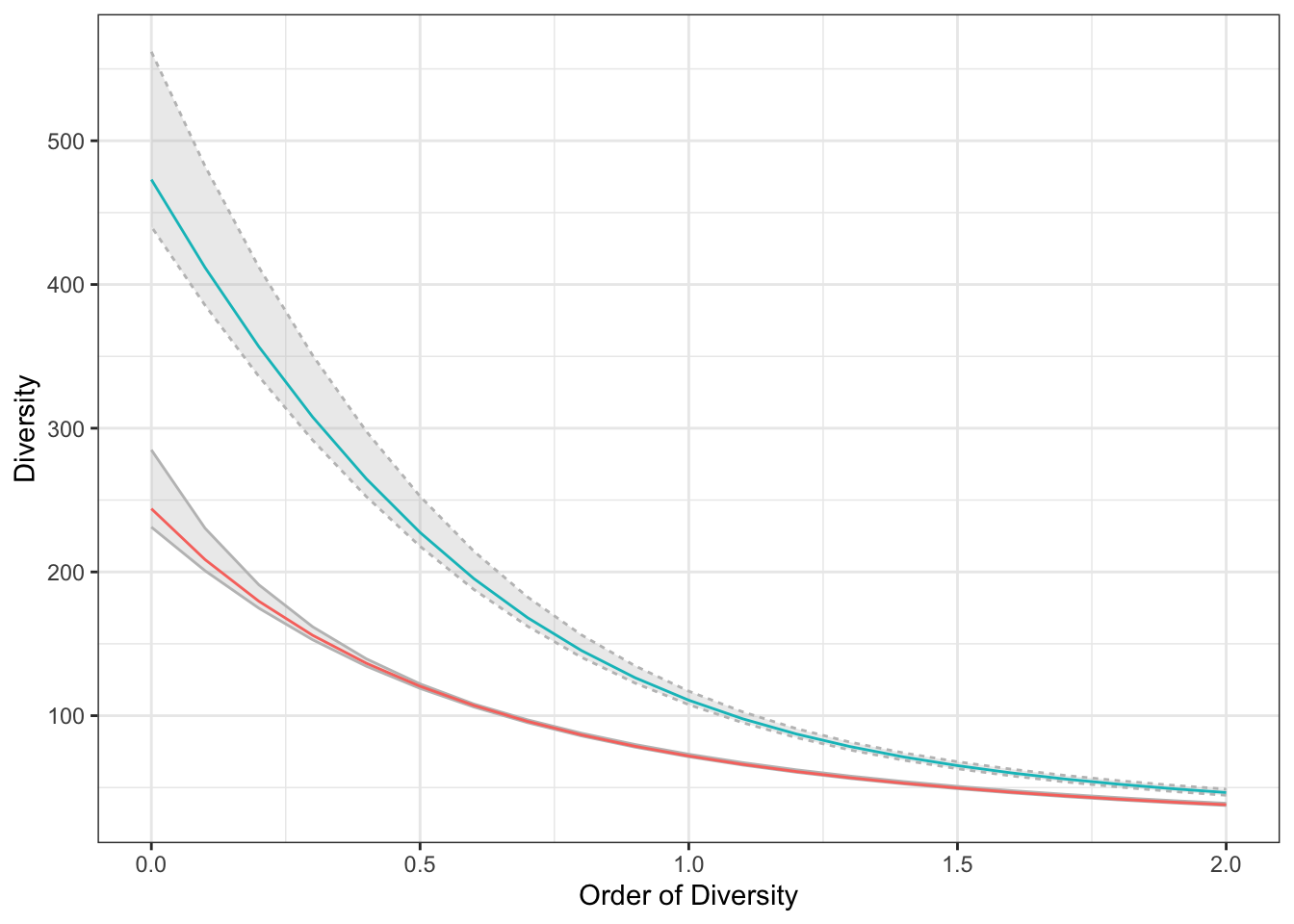
Profil de diversité de Paracou (courbe bleue) parcelle 6 et BCI (courbe rouge). La figure représente le nombre effectif d’espèces (nombre de Hill) en fonction de l’ordre de la diversité.
4 Discussion
MacArthur et Wilson (1967) montrent mathématiquement que la richesse spécifique (le nombre d’espèces) d’une île est un équilibre dynamique entre le taux d’immigration et le taux d’extinction, ce dernier étant directement dicté par la taille de l’île.
BCI est une forêt secondarisée (Raby 2017). Sa diversité pourrait être augmentée selon la théorie de la perturbation intermédiaire (Connell 1978).
References
Connell, Joseph H. 1978. « Diversity in tropical rain forests and coral reefs ». Science 199 (4335): 1302‑10. https://doi.org/10.1126/science.199.4335.1302.
Fadrique, B., F. Costa, F. Cuesta, et al. 2026. « Tree diversity is changing across tropical Andean and Amazonian forests in response to global change ». Nature Ecology & Evolution 10 (2): 267‑80. https://doi.org/10.1038/s41559-025-02956-5.
Gibson, Luke, Tien Ming Lee, Lian Pin Koh, et al. 2011. « Primary forests are irreplaceable for sustaining tropical biodiversity ». Nature 478 (7369): 378‑81. https://doi.org/10.1038/nature10425.
Gourlet-Fleury, Sylvie, Jean Marc Guehl, et Olivier Laroussinie. 2004. Ecology & management of a neotropical rainforest. Lessons drawn from Paracou, a long-term experimental research site in French Guiana. Elsevier.
Liang, Jingjing, Javier G. P. Gamarra, Nicolas Picard, et al. 2022. « Co-limitation towards lower latitudes shapes global forest diversity gradients ». Nature Ecology & Evolution 6 (août): 1423‑37. https://doi.org/10.1038/s41559-022-01831-x.
MacArthur, Robert H., et Edward O. Wilson. 1967. The theory of island biogeography. Monographs in population biology. Princeton University Press.
Marcon, Eric, et Florence Puech. under review. « divent: an R Package for Diversity Measures Based on Entropy ». Journal of Open Source Software, under review.
Patil, Ganapati P., et Charles Taillie. 1982. « Diversity as a concept and its measurement ». Journal of the American Statistical Association 77 (379): 548‑61. https://doi.org/10.2307/2287709.
R Core Team. 2026. R: A Language and Environment for Statistical Computing. R Foundation for Statistical Computing. https://doi.org/10.32614/R.manuals.
Raby, Megan. 2017. American tropics: the Caribbean roots of biodiversity science. Flows, migrations, et exchanges. The University of North Carolina Press.
Tothmeresz, Béla. 1995. « Comparison of different methods for diversity ordering ». Journal of Vegetation Science 6 (2): 283‑90. https://doi.org/10.2307/3236223.
Wright, S. Joseph. 2002. « Plant diversity in tropical forests: a review of mechanisms of species coexistence ». Oecologia 130 (1): 1‑14. https://doi.org/10.1007/s004420100809.